



Chromated Copper Arsenate Contamination in Wood Treatment Plants in Kenya: Environmental Levels and Influence of Simulated Rainfall on Leaching Rates
Sharolyne Atiang’
Department of Physical Sciences, School of Pure and Applied Sciences, Machakos University, P.O. Box 136-90100, Machakos, Kenya.
Elizabeth N. Ndunda
Department of Physical Sciences, School of Pure and Applied Sciences, Machakos University, P.O. Box 136-90100, Machakos, Kenya.
Veronica A. Okello *
Department of Physical Sciences, School of Pure and Applied Sciences, Machakos University, P.O. Box 136-90100, Machakos, Kenya.
*Author to whom correspondence should be addressed.
Abstract
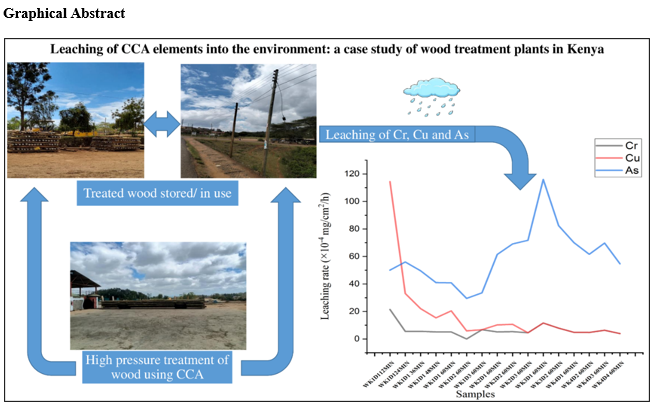
Chromated copper arsenate (CCA) is a water-based timber preservative containing heavy metals/metalloid, widely used in Kenya despite health concerns and restrictions in other parts of the world. Several studies have shown that CCA can leach from treated timber and be washed by rain into soils and aquatic systems. Research on the leaching and environmental occurrence of CCA components in Kenya remains limited, contributing to gaps in evidence-based policy formulation and enforcement regarding the use and management of CCA-treated materials. Additionally, there is no study that has been done to compare CCA contamination in multiple wood treatment plants in Kenya. This study aimed to determine the levels of Cr, As and Cu in soil and water in wood treatment plants and determine the effect of rainfall on the leaching of Cr, As and Cu from treated wood. Four wood treatment plants and one control site were included in this study. A total of ten soil samples were collected from the sites and analyzed for heavy metal concentrations using ICP-MS. Additionally, a commercially treated wood sample (20 kg/m3) was subjected to simulated rainfall conditions to evaluate the leaching rates of Cr, As, and Cu. Results indicated high heavy metal concentrations in wood treatment plants with the majority exceeding set guidelines. The concentrations ranged from <LOQ (Limit of Quantification) to 1309.50 ± 27.06 mg/kg for soil and 409.35 ± 5.36 to 81,688.53 ± 1,309.67 mg/kg for wood waste. Levels in drinking water were below the World Health Organization (WHO) guidelines of 0.01 mg/L for As, 0.05 mg/L for Cr and 2 mg/L for Cu. In the leaching experiments, quantified using ICP-OES, As exhibited the highest leaching rate of 116.00 × 10⁻⁴ mg/cm2/h. Cu leached more than Cr in the first week, after which their leaching rates became similar. The reported levels of CCA components in soil were above the Canadian guidelines which pose a significant risk to humans and animals requiring immediate action by the relevant authorities. Furthermore, these findings provide baseline data on environmental contamination by CCA, which is relevant insight to authorities towards minimized exposure risks among wood treatment workers in Kenya and the general population.
Keywords: Chromated copper arsenate, CCA, wood treatment plant, wood waste, heavy metals, leaching